

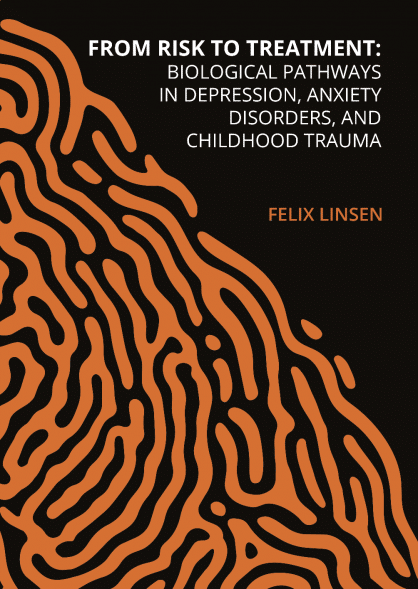
On Tuesday 23rd of June Felix Linsen will defend his PhD thesis titled ‘From Risk to Treatment: Biological Pathways in Depression, Anxiety Disorders, and Childhood Trauma’ in the Auditorium of the Vrije Universiteit Amsterdam at 13:45h.
In his dissertation Felix investigated the brain and biological mechanisms behind depression and anxiety, with a particular focus on the role of childhood trauma, and tested whether targeting the dysregulated stress system with medication can lead to better treatment outcomes.
From risk to treatment
Felix specifically looked at how brain networks function differently in people with these conditions, and how genetic variation in stress-dependent gene regulation relates to depression and anxiety disorders. In the RESET-medication study — a double-blind, placebo-controlled randomized clinical trial — Felix and colleagues tested whether a 7-day treatment with mifepristone (a medication that blocks a stress hormone receptor) could help people with depression and a childhood trauma history.
Findings
One brain network study showed that depression and anxiety were not associated with differences in how flexibly brain networks reorganise over time — but that antidepressant use was. This suggests that antidepressants may affect brain network dynamics, although we could not directly test how this relates to clinical response. In a second brain connectivity study, we identified four distinct connectivity states and found that having a depressive and/or anxiety disorder was associated with less segregated brain connectivity compared to healthy controls — but there was no difference between clinical groups with or without a childhood trauma history. In the genetic study, we found that individual variations in stress-related gene regulation are linked to having recurrent depressive episodes compared to a single episode. The RESET-medication trial, conducted in 158 adults with depression and a childhood trauma history, showed that while mifepristone produced the expected biological effect on the stress system, it did not lead to greater improvement in depressive symptoms compared to placebo.
Future approaches
“Our findings suggest that using brain connectivity or genetic biomarkers alone may not be sufficient to identify biologically distinct subgroups — for example, those defined by childhood trauma”, Felix concludes. Combining multiple types of biomarkers may provide more power to dissect the heterogeneity in depression and anxiety disorders and enable more targeted treatments. The RESET trial did not show efficacy of mifepristone, but it points the field toward more refined future approaches: the medication may still work for individuals with clear stress system dysregulation, and more insight into its mechanisms of action is needed.
On Tuesday 23rd of June Felix Linsen will defend his PhD thesis titled ‘From Risk to Treatment: Biological Pathways in Depression, Anxiety Disorders, and Childhood Trauma’ in the Auditorium of the Vrije Universiteit Amsterdam at 13:45h. Felix’s thesis is supervised by Prof. Dr. Mr. C.H. Vinkers and Prof. Dr. O.C. Meijer, and co-supervised by Dr. J.E. Verhoeven. More information on this dissertation can be found on the website of VU Amsterdam: PhD defence F. Linsen – Vrije Universiteit Amsterdam
Felix Linsen worked as a PhD candidate at the department of Psychiatry at Amsterdam UMC, conducting research within the RESET-medication project. From August 2026 onwards, Felix will work as an associate clinical study manager at Centre for Human Drug Research in Leiden.