


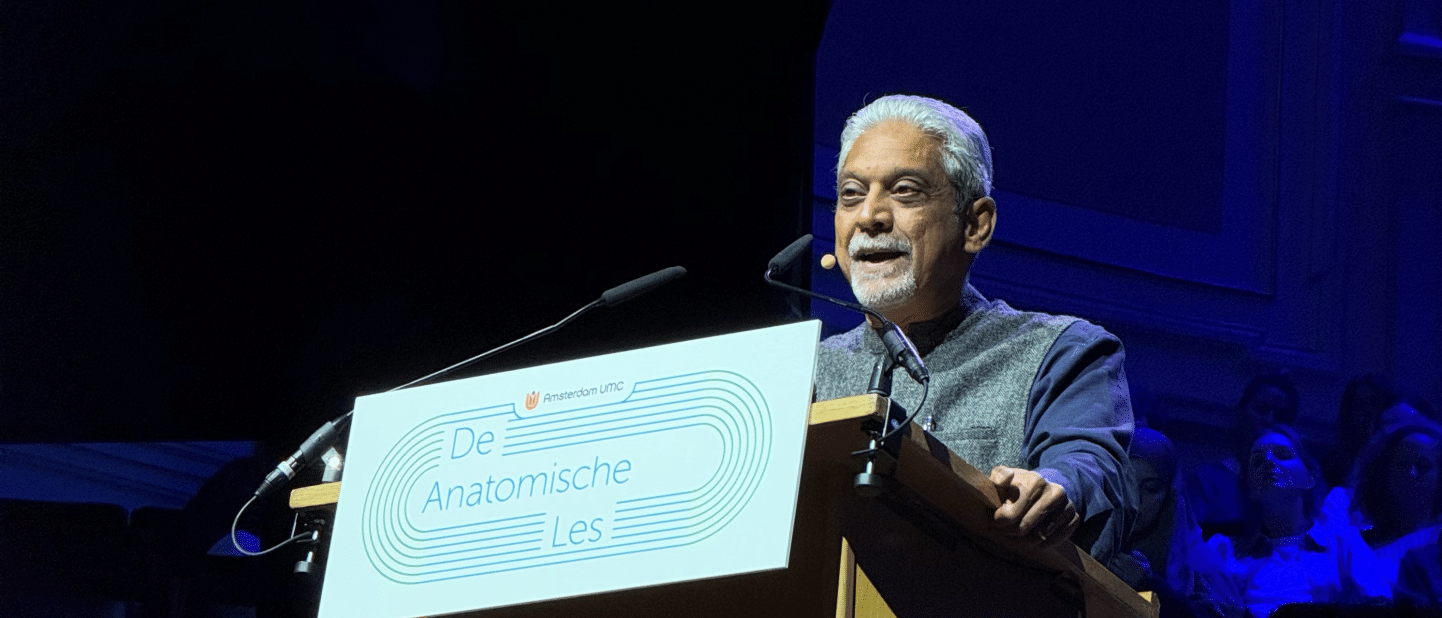
Following the 32nd Anatomy Lesson at the Concertgebouw, Harvard professor and psychiatrist Vikram Patel reflects on why modern mental healthcare needs to look beyond diagnostic labels, embrace community-based support, and focus on the human life story.
As the Paul Farmer Professor and Chair of the Department of Global Health and Social Medicine at Harvard Medical School, Professor Vikram Patel is a leading voice in reshaping how society approaches mental health. Patel has dedicated his career to challenging reductionist models of care and demonstrating that mental well-being cannot be isolated from a person’s social reality, environment, and lived experience. A pioneer in “task-sharing”—training community health workers and peers to deliver accessible psychological support in resource-poor settings—his work bridges rigorous epidemiological science with profound humanism.
What is the core message behind your lecture, ‘Reimagining Mental Health: Back to the Future’?
“We should examine a person’s mental health not through the narrow prism of a diagnosis or a label, but through the person’s life story. It is the interaction between our genes, our early life experiences, and what is currently going on in our life that really shapes our minds. Any attempt to categorize people’s mental health problems purely according to diagnostic labels is a doomed project because it only looks at what is observable to a clinician at a particular point in time. ‘Back to the future’ means blending the diagnostic system with older traditions from psychology and psychiatry that focused on the person and their story. Mental health is not like a disease that happens to you; it is perhaps the most fundamental part of our being. To understand my mental health, you have to understand me, not through a label, but by listening to my story.”
Despite substantial investments in science and care, mental health challenges keep rising globally. Where have we gone wrong?
“Over the last 15 years, countries like the Netherlands, Britain, Japan, and the United States have seen a worsening of mental health status, especially among young adults. It is incorrect to say we do not spend enough resources. The real problem is that the model of practice that gained prominence over the last 50 years is a very reductionist biomedical model. It focuses on a hypothesized chemical imbalance in the brain, for which there is really no evidence as a root mechanism. What you effectively do is control the symptoms without getting to the heart of the problem. It’s akin to saying that if you come to me with a severe cough and you are a heavy smoker, all I do is give you cough syrup.”
Your research spans evolutionary science, global health, and lived experience. How do these different perspectives help us build better care?
“The mind is a much more complex structure than any organ of the body, and the influences that shape it are unique to each individual. When we look at the biopsychosocial framework of mental health, psychiatrists often deal only with the ‘bio’ bit, while psychologists deal with the ‘psycho’ bit, leaving the ‘social’ bit out. In a community-based care model, we integrate mental health with frontline providers who deal with social determinants every day, alongside peer providers who bring lived experience. For prevention, we also have to look at early childhood adversities and adolescence—ensuring young people have nurturing environments—while building social policies for adults that promote social connectedness. For example, policies around public spaces and transportation, open recreation, even access to culture. Look at Zoran Mamdani in New York, he passed a regulation that gave away almost 70,000 free opera tickets.”
How can academic medical centers like Amsterdam UMC look beyond clinical treatment and help tackle the social drivers of mental health?
“It’s really important to move away from the notion that has dominated Western medical practice—that every individual is an atomic unit on their own—and recognize that we are all social creatures. For serious mental health conditions, psychiatric consults must be paired with continuing support in the community that engages a person’s social network. For common conditions like depression and anxiety, we should shift the locus of care toward primary care, ensuring skilled psychosocial providers offer brief, evidence-based treatments while connecting patients seamlessly to social welfare services. Recovery requires attention to internal coping skills as well as the immediate social difficulties people face, such as domestic violence, loneliness, or poor housing.”
What gives you optimism for the future of mental health care?
“Two things give me a lot of optimism. First, the level of stigma around mental health has declined dramatically everywhere. When people in the community start demanding better care, politicians respond. Second, our diagnostic systems are currently undergoing their biggest structural overhaul in 50 years because scientists and practitioners alike recognize that the current system has become a man-made trap. We have a growing body of science showing how to prevent and treat mental health conditions by targeting not just the biological end stage of a process, but its psychological and social roots. It’s a long game, but we are moving toward a truly person-centered system.”