

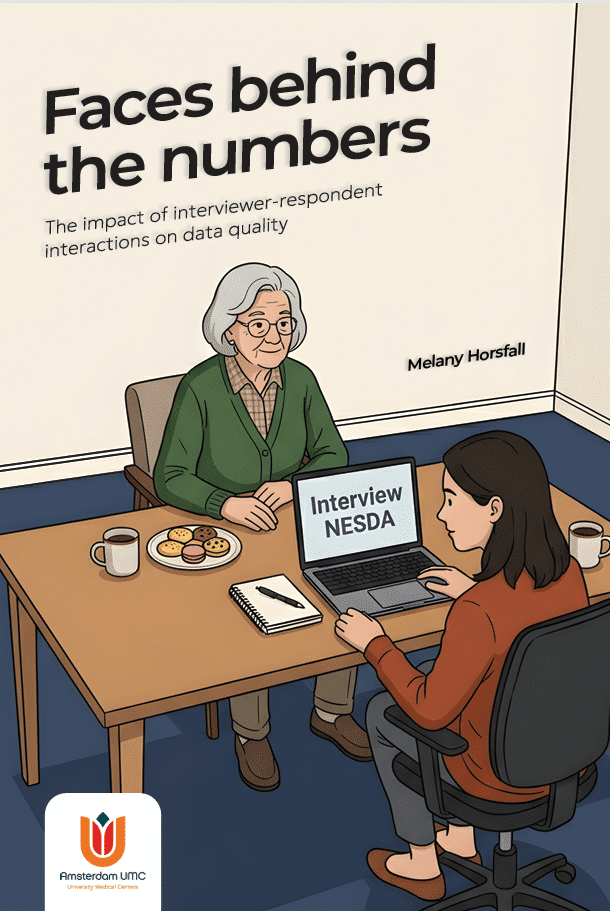
On Tuesday 20th of October Melany Horsfall will defend her PhD thesis titled ‘Faces Behind the Numbers: The impact of Interviewer–Respondent Interactions on Data Quality’ in the Aula of the VU Amsterdam at 11:45h.
In this thesis Melany investigated how interviewer–respondent interaction is related to data quality in the context of psychiatric research. Methodological issues are generally studied within survey research rather than psychiatric research. This thesis illustrates that attention to such methodological questions is also highly important in the context of psychiatric research. Various elements of interaction were examined, including deviant interviewer behaviour, interviewer repair strategies, rapport, the influence of sociodemographic characteristics, and their similarities. Also, different aspects of data quality were studied, namely participant attrition, item nonresponse, and socially desirable responses to sensitive questions.
Findings
Findings indicate that the interaction between interviewer and respondent during a research assessment can affect data quality. The relationship between interviewer and participant, also referred to as rapport, plays a role in this regard. Good rapport with participants was also associated with reduced attrition of respondents in follow-up assessments and a lower likelihood of item nonresponse. However, good rapport was also linked to more socially desirable responses. Respondents may be motivated to answer as completely as possible while simultaneously avoiding harming rapport by withholding socially undesirable answers.
Even though interviewers receive extensive training in standardised interviewing, deviations from standardisation and the use of repair techniques still occur frequently. The tendency to be helpful to respondents, as part of rapport building or retention, may explain this behaviour.
Another notable result was the association between participant age and rapport. Melany explains: “We found that older participants rated rapport with the interviewer less positively.” Older participants also exhibited higher item nonresponse and more socially desirable answers to sensitive questions, although the latter may reflect genuinely lower incidence of undesirable situations rather than social desirability bias. The less positive experience of rapport partially explained these findings among older participants.
Finally, psychiatric status of the respondent appears to play a role in both rapport building and data quality.
Focus on rapport
Although further improvements in the definition and operationalisation of rapport are needed for future studies to provide greater clarity, rapport appears to play an important role in the data collection process. This might especially be the case in psychiatric research, in which a relationship built on mutual trust and understanding is presumably even more important to motivate respondents to participate and discuss sensitive topics. Focus on building and maintaining rapport during interviewer training and supervision is therefore recommended.
On Tuesday 20th of October Melany Horsfall will defend her PhD thesis titled ‘Faces Behind the Numbers: The impact of Interviewer–Respondent Interactions on Data Quality’ in the Aula of the VU Amsterdam at 11:45h. Melany’s thesis is supervised by prof.dr. B.W.J.H. Penninx, dr. M. Eikelenboom, and dr. S. Draisma. More information on this dissertation can be found on the website of VU Amsterdam.
Melany Horsfall has combined her PhD research over the past years with her role as head of fieldwork and fieldwork coordinator for the department of Psychiatry at Amsterdam UMC. She will keep working as head of fieldwork in the department sharing the knowledge she obtained during her PhD to improve the data quality and interviewer-respondent interaction.